
Bracing for IVDD
IVDD Doesn't Have to End Their Walks. Motion Is the Medicine.
We know the moment. Your dog cried out, or couldn't get up, and the vet said two words: disc disease. Whether you chose surgery or conservative crate rest, you're now in a recovery battle no one prepared you for.
IVDD damages the cushioning between vertebrae. Stillness damages everything else. Spinal motion helps preserve intervertebral and nerve root spaces. Stillness lets them collapse. The Dynamic Mobility Brace Set restores controlled, supported motion at every step, the kind of input the recovering spine needs.
Designed by Dr. Huma Pierce DC, Postural Biomechanics Specialist, 25 Years Clinical Experience
Find My Dog's Fit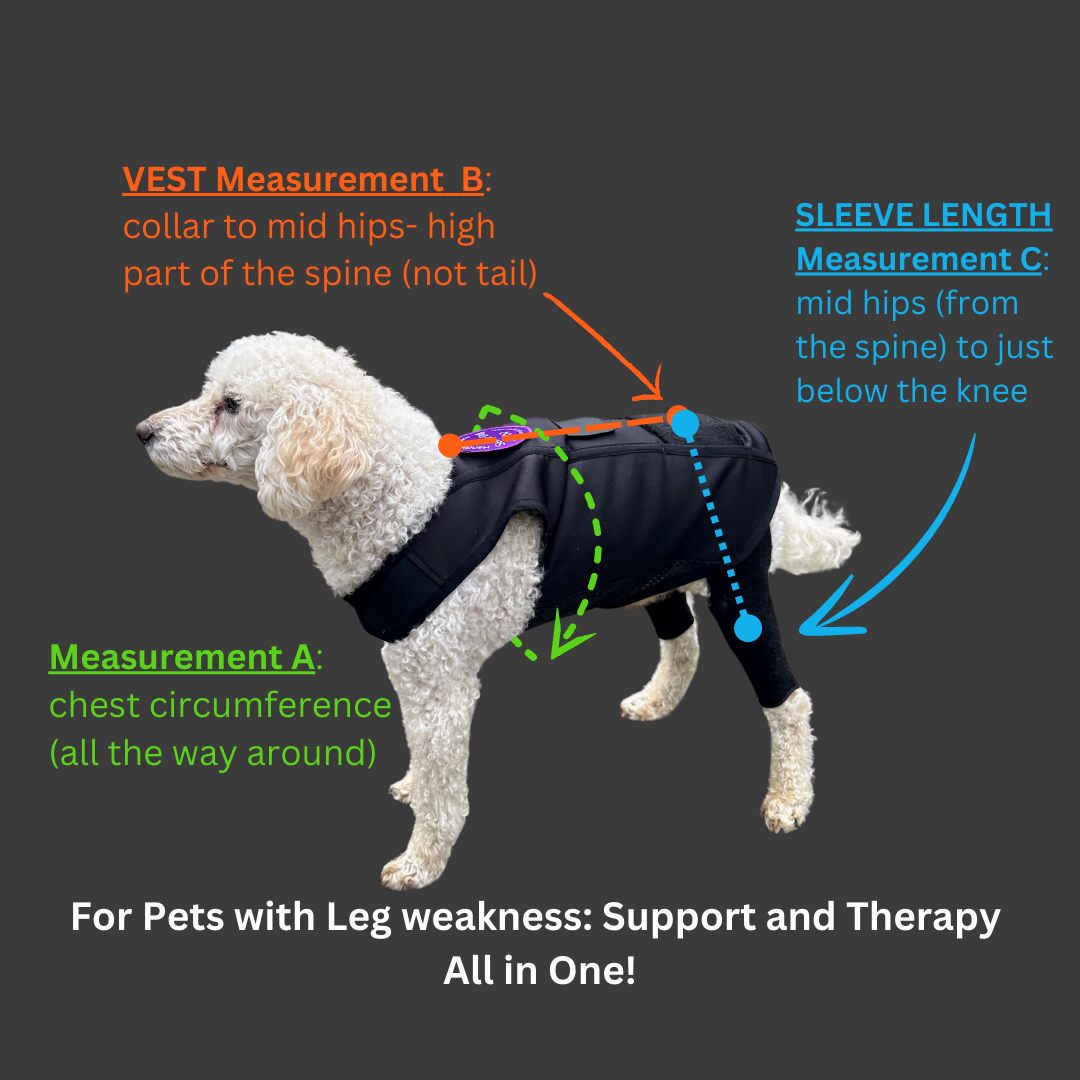
IVDD Narrows Disc Space. Active Motion Helps Keep It Open.
When you watched your dog's back legs give out, the floor dropped out with them. That instinct to act, to do something, anything, is the right one. We have something.
Intervertebral disc disease, IVDD, is the most common spinal disorder in dogs. The cushioning discs between vertebrae degenerate, herniate, or rupture, pressing on the spinal cord and nerve roots. Pain comes first. Knuckling, hindlimb weakness, paresis, and in severe cases paralysis can follow. Chondrodystrophic breeds, dachshunds, French bulldogs, beagles, cocker spaniels, are most often affected, but any breed can be diagnosed.
What surprises most owners is what happens after the acute event. Whether your dog has surgery or follows conservative crate rest, the spine that comes through the other side is stiffer, more guarded, and more vulnerable than the one that went in. Compensatory immobility lets vertebrae draw closer together. Intervertebral and nerve root spaces narrow. The risk of re-extrusion at the same site, or at the level above and below, climbs.
This is where motion matters. Spinal segments that move regularly tend to retain their height. Nerve root foramina stay open. The musculature surrounding the spine stays symmetrical and engaged. Stillness reverses every one of those gains.
Cooper had IVDD diagnosed at L5 and L7. He should have had two, maybe three more years. Wearing the Dynamic Mobility Brace, he walked beside his family for seven.
Cooper Pierce, 2005 to 2025. The brace was designed for him.
Dr. Huma Pierce DC
The Dynamic Mobility Brace Set: How It Supports an IVDD Spine
This is not a compression wrap. It is a two-piece active therapy system built from aerospace-grade bio-responsive materials and 25 years of postural biomechanics research. Your dog's recovery deserves that level of care.
The vest anchors support across the trunk, neck, and pelvis, the regions an IVDD-recovering dog tends to splint and brace against. By supporting the body around the affected spinal segments, it reduces the reflex to guard, freeing the dog to move more naturally and load the spine through its full physiological range.
The patented spring sleeves deliver continuous proprioceptive input to each hindlimb during movement. That input drives symmetrical, weight-bearing motion through the spine, the kind of motion that helps maintain intervertebral height and foraminal openings. The dog walks, the spine works, the spaces stay open.
Whether your dog is post-surgical or in conservative management, recovery depends on dose. The brace turns ordinary backyard walks into therapeutic loading sessions, no clinic visits, no scheduled rehab, no missed days. Active motion, daily, is what the recovering spine needs.
"In the dogs who can still walk, even imperfectly, we see measurable change in posture, gait, and confidence within weeks. Motion is the medicine."
Your IVDD Dog Is a Candidate If They Present With:
If you have heard the words 'disc disease,' you are already living with the weight of it. Whether you went the surgical route or the conservative one, the next chapter is recovery and protection. The brace was built for that chapter.
These are the early-to-mid recovery signs that respond best to active dynamic bracing. The earlier you intervene during recovery, the more spinal motion you preserve.
- ✓Recently diagnosed with IVDD and still ambulatory, the optimal window to begin
- ✓Post-surgical recovery from hemilaminectomy or other spinal surgery, cleared by your vet to begin walking
- ✓Conservative management of an acute disc episode and ready to graduate from crate rest
- ✓Knuckling, scuffing, or dragging of the rear paws after a disc event
- ✓Hindlimb weakness, swaying, or wobble during normal walking
- ✓One IVDD episode already on record and you want to protect against another
Not sure if your dog qualifies? Text Dr. Pierce directly at 480-674-2216. She will listen, assess, and give you an honest answer.

Dogs Who Walked Past Their Diagnosis.
Real reviews from real families. Cooper is the dog the brace was built for, and the IVDD case it was designed around. Cassie and Bella are part of the more than 4,800 dogs braced since.
Cooper had IVDD diagnosed at L5 and L7. He should have had two, maybe three more years. Wearing the Dynamic Mobility Brace, he walked beside his family for seven.
Within a week of using it a few hours a day, Cassie looked more supported and steadier. The biggest win was that she started getting her confidence back on walks. The brace itself is 5/5 stars. Customer service is 10/10. The doctors helped me with fit, answered my questions, and made sure I felt happy using it correctly.
Our beloved Irish doodle Bella has been wearing the Lucky and Loyal brace for over a year and it is a GAME CHANGER. She was experiencing increased instability in her back legs and hips. By some miracle we found Lucky and Loyal and it is like we have our younger puppy back! I cannot recommend this brace enough!
Cassie and Bella are not IVDD cases, they are senior dogs whose hindlimb instability mirrors many IVDD recovery profiles. Their reviews speak to the brace's effect across mobility conditions. Used with the families' permission.
IVDD Took One Step. Don't Let It Take the Rest.
You found this page because the diagnosis didn't stop you. It made you fight harder. That is the kind of dog parent we built this for.
The Dynamic Mobility Brace Set is the only self-propelled home device designed to deliver active controlled motion that helps preserve intervertebral and nerve root spaces during IVDD recovery. Start now. Every walk matters.
Find the Right Brace


